
A valley village on Black Earth Creek, at the edge of the last glacier
Tree Service in Cross Plains, WI
Oaks, bluffs and creek-bottom yards call for different approaches.
- On-site quotes at no charge in Madison and Dane County
- Written, line-by-line pricing up front
- Agreed cleanup, no surprises after the job
Two Landscapes Meet at Cross Plains
Cross Plains sits right on one of the most studied boundaries in Wisconsin: the edge of the last glaciation. The Ice Age Trail segment through the village follows Black Earth Creek in a valley between tall bluffs, with glaciated land to the east and north and the Driftless Area to the west and south. Just outside the village, the Wilkie Gorge unit of the Ice Age National Scientific Reserve is described as a world-renowned example of the meeting of glaciated and unglaciated terrain, marked by the Johnstown Moraine. For tree service in Cross Plains, that geology is not trivia. It decides how deep the soil is, how steep the yard is and what kind of trees are growing on it.
Valley floor, slope and ridge
A quick way to think about Cross Plains properties:
- Creek valley lots near Black Earth Creek tend to be flatter and wetter. Trees there can grow large, and saturated soil after heavy rain is the main hazard.
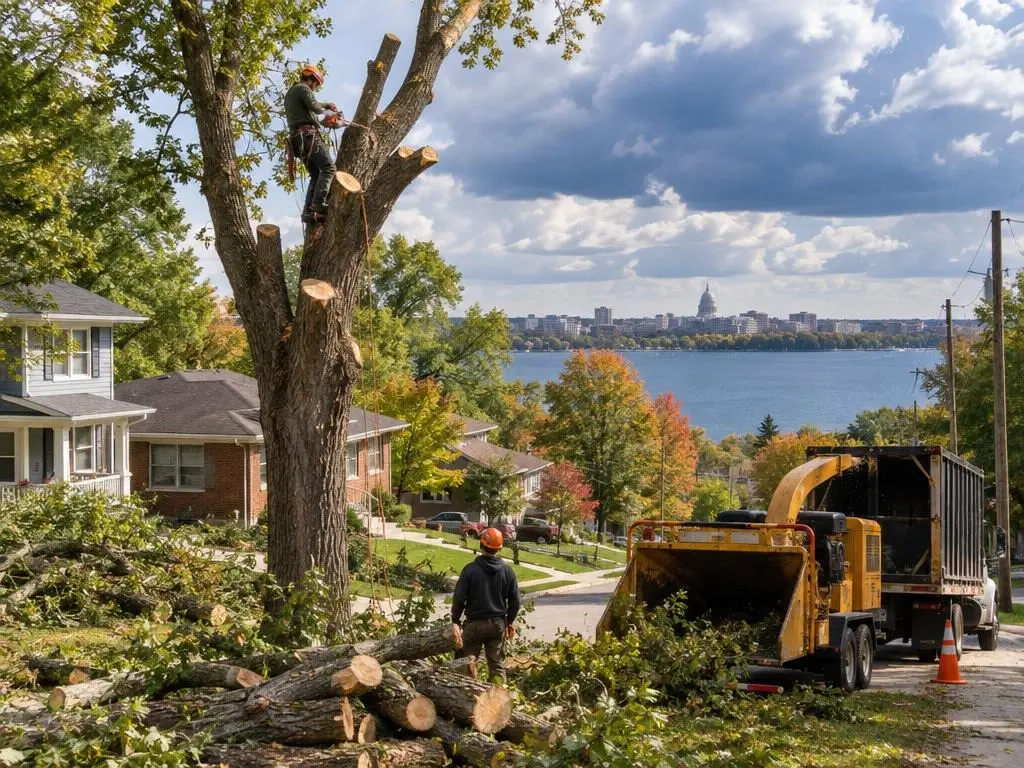
- Slope lots climbing the bluffs are where removals get complicated. Dropping a tree downhill can send it farther than its height, and equipment cannot always reach. These jobs are usually done by climbing and lowering pieces on ropes.
- Ridge and Driftless-side lots to the west can sit on thin soil over shallow bedrock, which the Driftless Area literature notes limits tree growth on ridgetops. Trees there are often shallow-rooted and more exposed to wind.
We look at all three things on a visit: soil, slope and exposure.
Oaks are a big part of the picture
The natural communities around the reserve include oak savanna and oak forest, and where a village yard has oaks, they are long-lived and worth protecting, but they come with one firm rule: avoid pruning or wounding them from April through July, when the Wisconsin DNR says sap beetles carry oak wilt to fresh cuts. Red and black oaks can die within weeks of infection; white and bur oaks resist it better but are not immune. The fungus also spreads underground between oaks through grafted roots, so one infected tree can threaten a neighbor's.
Typical work in and around the village
1. Dormant-season pruning of mature oaks over houses and driveways 2. Removal of dead ash in the creek valley and along fence lines 3. Rope-rigged removals on steep back slopes 4. Clearing limbs over long rural driveways in the surrounding town 5. Stump grinding on lots where a slope makes regrading hard
A small village with room around it
The village covers about 1.8 square miles and had 4,104 residents in 2020, and it sits partly within the Town of Cross Plains, a rural town of about 35 square miles that also includes Pine Bluff. Many of our calls come from those larger rural properties, where a single storm can drop several trees across a driveway or fence.
Before you cut on a slope
If you are thinking about clearing trees on a hillside for a view, start small. Roots hold steep soil in place, and removing several trees at once can lead to erosion. Thinning and limbing up often open a view with far less risk.
Call (608) 820-8710 or send the form to set up a free estimate. For hillside jobs, a photo from the bottom of the slope helps us plan. Get a free estimate
Cross Plains Geography and Facts
- Edge of the last glaciation. The Ice Age Trail segment through Cross Plains runs along Black Earth Creek in a valley between bluffs, with glaciated land east and north and the Driftless Area west and south.
- Wilkie Gorge reserve. The nearby Cross Plains unit of the Ice Age National Scientific Reserve, marked by the Johnstown Moraine, includes oak savanna, oak forest, wetland and prairie.
- Thin ridgetop soils. In the Driftless Area, bedrock sits close to the surface in many places, and thin soils on ridgetops limit tree growth, according to the region's geologic descriptions.
- Village and town. The village, incorporated in 1920, had 4,104 residents in 2020 on about 1.8 square miles; the surrounding Town of Cross Plains covers roughly 35 square miles.
Our Services in Cross Plains, WI
Cross Plains Questions
Can you remove a tree on a steep slope behind my Cross Plains house?
Yes. On bluffs and steep yards we usually climb the tree and lower it in sections with ropes, so nothing tumbles downhill. Access and the number of pieces drive the price, and the written estimate spells out the plan.
My neighbor's oak died fast in summer. Should I worry about mine?
Possibly. Oak wilt spreads through connected roots between nearby oaks as well as by beetles. Have your oaks checked, and avoid any pruning or wounding from April through July.
Do you work on rural properties outside the village?
Yes. We work throughout the Town of Cross Plains, including large lots and long driveways where storm damage takes more cleanup.
Free Estimates in Cross Plains, WI
Free estimates on valley, slope and ridge properties around Cross Plains.
Tree Service Near Cross Plains
- Tree Service in Madison, WI
- Tree Service in Middleton, WI
- Tree Service in Fitchburg, WI
- Tree Service in Sun Prairie, WI
- Tree Service in Verona, WI
- Tree Service in Monona, WI
- Tree Service in Waunakee, WI
- Tree Service in McFarland, WI
- Tree Service in Stoughton, WI
- Tree Service in Oregon, WI
- Tree Service in Cottage Grove, WI
- Tree Service in DeForest, WI
- Tree Service in Maple Bluff, WI
- Tree Service in Shorewood Hills, WI
- Tree Service in Mount Horeb, WI
- Tree Service in Windsor, WI
- Tree Service in Westport, WI
- Tree Service in Belleville, WI
- Tree Service in Marshall, WI
- Tree Service in Black Earth, WI
- Tree Service in Lodi, WI