
A small city on Lake Monona, wrapped almost entirely by Madison
Tree Service in Monona, WI
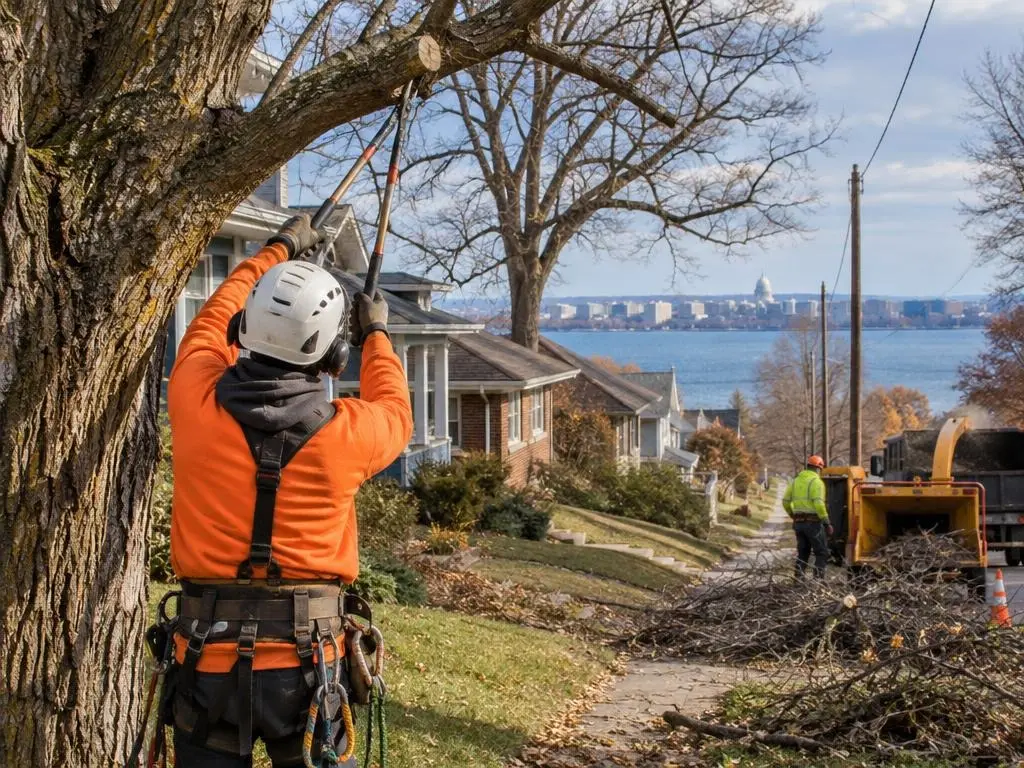
Mature trees on mid-century lots, handled with Monona's tree code in mind.
- On-site quotes at no charge in Madison and Dane County
- Written, line-by-line pricing up front
- Agreed cleanup, no surprises after the job
Seventy-Year-Old Neighborhoods Grow Seventy-Year-Old Trees
Monona's population more than tripled in the 1950s, from 2,544 to 8,178, after the area went from farmland and summer homes to an incorporated village in 1938. Many of the city.s houses and yard trees date from that boom, which is why tree service in Monona so often means big, mature canopy over modest lots. Trees planted beside a new ranch house in 1955 are now taller than the house, rooted under the driveway and leaning over the neighbor's garage. Those trees can stay healthy for decades more with the right pruning, but they also need someone to keep an eye on deadwood, weak unions and decay at old pruning cuts.
Monona's tree code has some unusual rules
Chapter 411 of the city code sets out the public tree program, and a few provisions are worth knowing:
- A permit from the City Forester is needed to plant, trim, remove or damage a tree or shrub on public property, and permits are only issued when the work is needed because of disease, damage, hazard or location.
- When a public tree is removed, the stump must be ground or grubbed at least nine inches below grade.
- Digging or paving within 10 feet of a public tree requires a permit.
- The code restricts planting female cottonwood and seed-bearing box elder, declares box elder a nuisance and requires owners to remove such trees.
- The City Forester can declare any tree a public nuisance if it is diseased, infested or endangers people or property; on private land the owner must abate it when ordered.
If you have received a notice about a box elder or a hazard tree, call us with the deadline on the letter and we will work to it.
Water on two sides
Monona lies along the southeastern shore of Lake Monona, and the Yahara River runs through the city. Lakeside and riverside lots bring their own problems: trees that lean out over the water toward the light, soil that stays wet, and limited access for equipment. Removing a tree over a shoreline usually means rigging pieces down by rope instead of felling, so nothing lands in the water or on a dock.
Brush after the job
Monona collects brush on scheduled weeks, with a total pile size limit of 4 by 4 by 10 feet per residence and a rule against setting brush out more than 14 days early. The city has no brush drop-off site, and for disposal outside the schedule it tells residents to contact a private contractor; the Dane County Landfill takes brush for a fee. A full tree removal produces far more than one pile, so our estimates include chipping and hauling.
Storm years
After the June 13, 2022 storms, Monona sent crews with front-end loaders to pick up large curbside limbs until July 1. That is a helpful service for wood that has already fallen. For a cracked limb still hanging in a tree, or a whole tree on a roof, call us.
An older population
Census QuickFacts reports that 21.9% of Monona residents are 65 or older, a higher share than nearby suburbs, and 86.5% lived in the same house a year earlier. Many owners have cared for the same trees for decades and simply want someone else to do the climbing now. We are glad to set up periodic visits.
Phone (608) 820-8710 or use the form to arrange a free estimate. We will walk the lot with you and put every item in writing. Get a free estimate
Monona Code and Community Facts
- Box elder is a declared nuisance. Monona code section 411-9F restricts planting seed-bearing box elder and female cottonwood, declares box elder a nuisance and requires owners to remove such trees.
- Public tree permits and stumps. A City Forester permit is required to plant, trim or remove a public tree (411-10B), and removals require the stump ground or grubbed at least 9 inches below grade (411-10A).
- Brush pile limits. Curbside brush may total 4 by 4 by 10 feet per residence, set out no more than 14 days early; the city has no drop-off site, and the Dane County Landfill accepts brush for a fee.
- 1950s growth. Monona incorporated as a village on August 29, 1938 and as a city in 1969; its population rose from 2,544 to 8,178 during the 1950s.
- Older, settled residents. Census QuickFacts reports 21.9% of residents are 65 or older, a 53.6% owner-occupied rate and a $427,900 median owner-occupied home value.
Monona Questions
I got a letter from Monona about the box elder in my yard. What now?
The city code declares box elder a nuisance and allows the City Forester to order removal. Note the deadline on the letter and call us; we can give you a written quote for removal and stump grinding that fits the timeline.
Can you remove a tree that leans over Lake Monona?
Usually, yes. Over water or a dock, we take the tree apart in sections and lower them on ropes instead of dropping it whole. Access along the shore is the main factor in price.
Where can I take branches if I miss Monona's brush week?
Monona does not run a brush drop-off site. You can wait for the next scheduled week, take it to the Dane County Landfill for a fee, or have a contractor haul it.
Free Estimates in Monona, WI
Free estimates across Monona, from the lakeshore to Monona Drive.
Tree Service Near Monona
- Tree Service in Madison, WI
- Tree Service in Middleton, WI
- Tree Service in Fitchburg, WI
- Tree Service in Sun Prairie, WI
- Tree Service in Verona, WI
- Tree Service in Waunakee, WI
- Tree Service in McFarland, WI
- Tree Service in Stoughton, WI
- Tree Service in Oregon, WI
- Tree Service in Cottage Grove, WI
- Tree Service in DeForest, WI
- Tree Service in Maple Bluff, WI
- Tree Service in Shorewood Hills, WI
- Tree Service in Cross Plains, WI
- Tree Service in Mount Horeb, WI
- Tree Service in Windsor, WI
- Tree Service in Westport, WI
- Tree Service in Belleville, WI
- Tree Service in Marshall, WI
- Tree Service in Black Earth, WI
- Tree Service in Lodi, WI